A common mistake on Brownsville construction sites is assuming that count and lift thickness alone guarantee adequate compaction. The expansive clay soils common in the Rio Grande Valley can look dense at the surface while hiding voids and under-compacted layers beneath. Without a direct measurement of in-place density, contractors risk differential settlement that shows up months after project completion—cracking pavements on Boca Chica Boulevard or shifting building pads near the Port of Brownsville. The sand cone method, performed in strict accordance with ASTM D1556, provides verifiable density readings that no nuclear gauge proxy can match when dealing with the variable moisture contents typical of Cameron County subgrades. Our field crew runs these tests while earthwork operations continue, delivering results that keep the job moving and the owner’s geotechnical engineer confident in the compaction record.
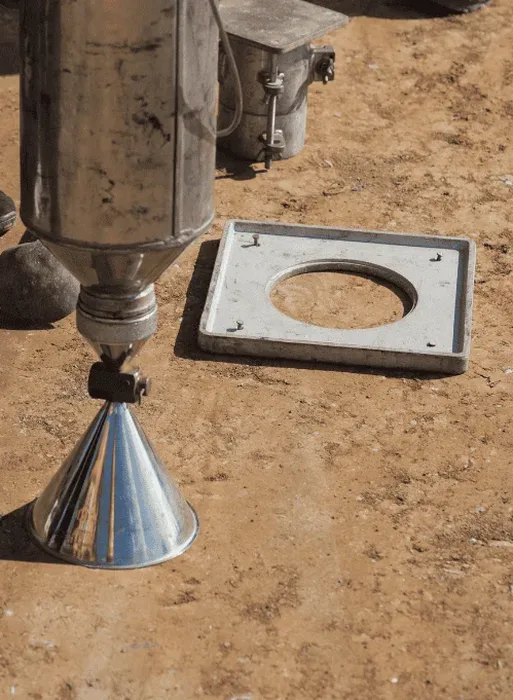
On Brownsville clay fills, a sand cone test gives you the one number that matters: actual pounds per cubic foot of compacted soil, not an inferred reading from a radiation source.
Technical details of the service in Brownsville Texas
Risks and considerations in Brownsville Texas
The city of Brownsville sits at an average elevation of just 33 feet above sea level, with much of the urban footprint built on Quaternary alluvial deposits of the Rio Grande floodplain. High groundwater, seasonal flooding, and shrink-swell clay behavior combine to make compaction control more than a specification checkbox—it is the primary defense against post-construction settlement. When a fill lift tests below 95 percent of standard Proctor density in these conditions, the risk is not theoretical. Water infiltrates the uncompacted voids, the clay matrix softens, and bearing capacity drops during the very wet season when the site is already saturated. We have seen foundation backfill on residential lots near Resaca de la Palma fail density retests simply because the contractor compacted at moisture contents two percent above optimum. The sand cone test catches that discrepancy before the slab is poured, when the fix is still just recompaction, not demolition.
Our services
Our field density testing services in Brownsville are designed to integrate directly with earthwork operations and provide the documentation that owners, geotechnical engineers, and municipal inspectors require. Each test is performed by a technician trained under our ISO 17025-accredited laboratory protocols.
In-Place Density by Sand Cone (ASTM D1556)
Full field determination of wet density, dry density, and percent compaction for fill lifts, utility trench backfill, and building pad subgrades. Includes moisture content by oven-dry method, calibrated sand cone apparatus, and a signed field report with station referencing.
Compaction Verification Package
Combined laboratory and field service: we run the Proctor curve on your borrow material, then mobilize to the Brownsville site for sand cone testing against that reference curve. The package includes control charts showing density and moisture trends across multiple lifts, helping the superintendent spot compaction drift before it becomes a failing test.
Questions and answers
How much does a field density test with the sand cone method cost in Brownsville?
When is the sand cone method preferred over a nuclear density gauge in Brownsville soils?
The sand cone method is the reference standard when nuclear gauge readings become unreliable—common in the high-plasticity Beaumont and Lissie Formation clays found across the Brownsville area. Variable moisture, organic lenses, and the presence of caliche fragments can skew nuclear gauge calibration. Sand cone testing also avoids the regulatory requirements and licensing associated with radioactive sources, which simplifies access to Port of Brownsville and federal construction sites.
How many density tests does the City of Brownsville require for fill placement?
Most project specifications in Brownsville follow IBC Section 1804 guidelines, requiring a minimum of one field density test per 2,500 square feet of each compacted lift, or per 150 cubic yards of fill placed, whichever yields more tests. Utility trench backfill in public right-of-way typically requires a test every 50 linear feet per lift. We coordinate directly with the city inspector and the geotechnical engineer of record to match the testing frequency to the approved earthwork submittal. More info.