A warehouse slab in the new industrial park off I-69E started showing quarter-inch settlement cracks barely six months after the tilt-wall panels went up. The contractor swore the fill had been compacted properly, but the field density logs told a different story once we correlated them against a proper laboratory moisture-density curve. In Brownsville, where the near-surface soils shift from Laredo Formation silts to Beaumont clay within a few hundred lateral feet, the difference between a quick drive-tube check and a full Proctor test is the difference between a five-year floor and one that outlasts the mortgage. The Proctor test determines the maximum dry density and optimum moisture content for a given soil, establishing the target that every lift of structural fill must hit. Without that reference curve, a nuclear gauge reading on a sand cone density verification is just a number with no engineering context.
A Proctor curve built on the wrong borrow source is worse than no curve at all – it gives you a target that doesn’t match the soil under the roller.
Technical details of the service in Brownsville Texas
Risks and considerations in Brownsville Texas
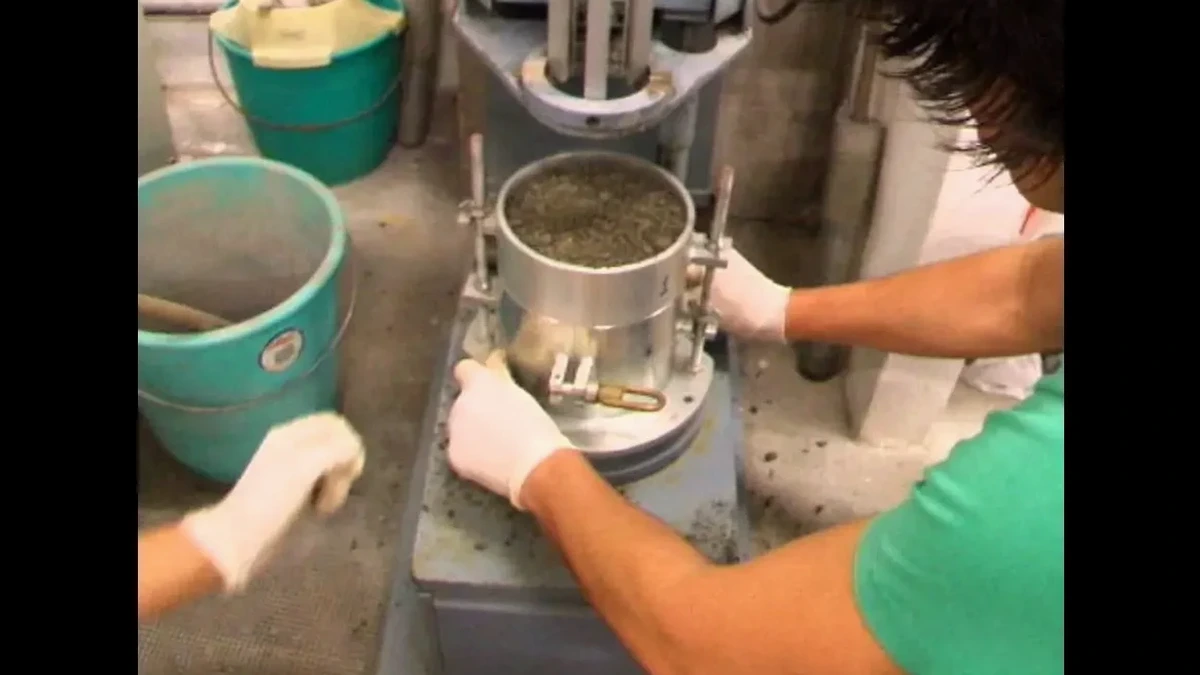
The Proctor hammer assembly sits on a solid concrete pedestal in the lab, a standardized mechanical compactor that delivers a precise energy per blow – 5.5 pounds dropping 12 inches for the standard effort, or 10 pounds dropping 18 inches for the modified procedure. The mold gets filled in three or five equal lifts, each one scarified before the next goes in, and the whole sequence runs point-by-point across at least four moisture contents to bracket the peak of the curve. When a Brownsville contractor calls asking why field density tests are failing when the roller made the pass count, the first thing we check is whether the lab curve was run on a bulk sample that actually represents the fill being placed. A borrow source that changes from tan silty clay to gray fat clay at depth will produce a different optimum moisture content, and the compaction crew needs the curve that matches what’s coming out of the scraper that day. For deeper foundation influence zones, understanding how the compacted fill interacts with the native stratum matters, and the Proctor parameters feed directly into settlement calculations and mat foundation design assumptions.
Our services
Proctor testing in the Lower Rio Grande Valley works best when the lab curve and the field verification are run as a single closed loop. The compaction specification means nothing unless the crew on the ground understands what moisture range to hold and what density number to chase. Our Brownsville-area compaction control support covers the full sequence from laboratory moisture-density relationship development through field nuclear gauge correlation and lift-by-lift documentation.
Laboratory Proctor Curve Development
Standard (ASTM D698) or Modified (ASTM D1557) moisture-density relationship on representative bulk samples from the project borrow source. Includes oversize correction per ASTM D4718 when gravel or caliche fragments exceed the allowable fraction, and a companion Atterberg limits determination to characterize the fines fraction.
Field Density Testing & Compaction Verification
Nuclear gauge density testing (direct transmission) on compacted lifts, correlated to the project-specific Proctor curve. Each test location reports wet density, dry density, moisture content, and percent compaction relative to the specified maximum. Written reports include lift thickness verification, pass/fail criteria per the project specification, and recommendations for rework when densities fall below the threshold.
Questions and answers
What is the difference between Standard and Modified Proctor, and which one does my Brownsville project need?
Standard Proctor (ASTM D698) delivers 12,400 ft-lbf/ft³ of compactive energy and simulates the effort of lighter compaction equipment typical of trench backfill and landscaping fills. Modified Proctor (ASTM D1557) delivers 56,000 ft-lbf/ft³ and replicates modern heavy rollers and vibratory compactors. Most structural fill specifications in Brownsville – building pads, road subgrade, utility trench backfill under pavement – require Modified Proctor at 95% or 98% of maximum dry density. Standard Proctor is occasionally specified for non-structural fills, landscape areas, or where the design intentionally limits compaction to avoid overstressing adjacent utilities.
How long does it take to get a Proctor curve back from the lab?
A single-point Proctor (one moisture-density pair, often used for field correlation checks) can be turned around in 24 hours. A full four-point or five-point curve, which requires drying back and re-wetting the sample to bracket the peak, typically takes two to three working days. Expedited same-day or next-day turnaround is available when the compaction crew is standing by and needs the target numbers immediately.
What does Proctor testing cost for a typical Brownsville project?
Can you run a Proctor on soil that has gravel or caliche mixed in?
Yes, but the procedure adjusts depending on how much oversize material is present. ASTM D4718 provides the correction method when the plus-No. 4 fraction exceeds about 5 percent by mass. For Brownsville soils that contain caliche fragments or crushed limestone base, we run the appropriate mold size (6-inch diameter for Method C when plus-No. 4 exceeds 20 percent) and apply the oversize correction to the reported maximum dry density and optimum moisture content. The corrected curve gives the field crew a realistic target that accounts for the aggregate fraction.
What happens if the field density test fails even though the roller made the specified number of passes?
A failing density test usually traces back to one of three causes: the moisture content is too far off optimum (either too dry or too wet), the lift thickness exceeds what the roller can effectively compact, or the Proctor curve was developed on soil that does not match what is actually being placed. We troubleshoot by checking in-place moisture against the lab optimum, verifying lift thickness with a probe, and re-running a one-point Proctor on the material in question to confirm the target curve is still valid. Adjusting moisture, reducing lift thickness, or switching to a heavier compactor typically resolves the issue.