Brownsville averages 27 inches of rain a year, and when summer storms hit the Rio Grande Valley, the clay underneath swells fast. That swell can add thousands of pounds of lateral pressure to a wall that wasn't designed for it. We see it in older subdivisions near downtown and in new commercial lots along I-69E. Our retaining wall design here starts with one thing: knowing exactly what the soil will do when it gets wet. Before finalizing a wall section, we often run test pits to log the clay profile and confirm the depth to the Beaumont Formation, which dominates the subsurface across Cameron County.
In the Valley, a retaining wall fails from the bottom up—poor base drainage destroys more walls than backfill pressure ever will.
Technical details of the service in Brownsville Texas
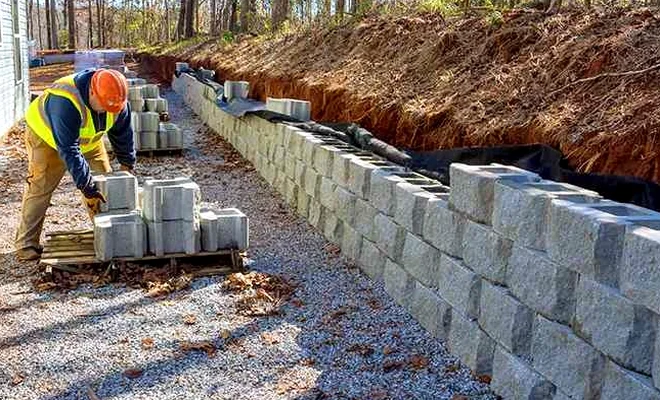
Risks and considerations in Brownsville Texas
The biggest surprise on a Brownsville jobsite is finding a sand lens in the middle of a clay profile. These lenses, remnants of old Rio Grande channel deposits, act like perched aquifers. Build a wall across one without a drainage plan and hydrostatic pressure builds behind the stem in days. We've analyzed this on projects near the Resaca de la Palma and along FM 511. Another risk is using a standard gravity wall section designed for Dallas clay—it won't hold here because the plasticity index of Beaumont clay can exceed 35. That means higher swell pressure and a larger required base width. We model these conditions in GeoStudio SLOPE/W and check external stability for sliding, overturning, and bearing capacity using allowable stress design per NCMA's Design Manual for Segmental Retaining Walls, supplemented with Texas-specific rainfall data.
Our services
Our retaining wall design services encompass the complete engineering workflow, encompassing subsurface investigation through construction submittals.
Geotechnical Investigation for Walls
Soil borings and test pits to log stratigraphy, measure plasticity index, and collect undisturbed samples for shear strength testing.
Internal & External Stability Analysis
Calculations for sliding, overturning, bearing capacity, and global slope stability using Spencer's method with local groundwater conditions.
Construction-Ready Wall Plans
Stamped drawings showing wall geometry, reinforcement schedule, drainage details, and backfill specifications for City of Brownsville permit review.
Forensic Wall Evaluation
Investigation of leaning or cracked walls: we measure tilt with inclinometers, log distress patterns, and recommend repair or replacement strategies.
Questions and answers
What type of retaining wall works best in Brownsville's expansive clay?
Cast-in-place cantilever walls with a properly compacted select fill backfill zone work well because they can be designed to resist the swell pressure directly. Segmental block walls are also common for heights under 6 feet, but they require a wider reinforced zone and careful drainage detailing per NCMA guidelines. The key factor in Brownsville is the plasticity index of the native Beaumont clay—values above 30 require swell pressure estimates using ASTM D4546 or local empirical data from Cameron County.
Do I need a building permit for a retaining wall in Brownsville?
Yes. The City of Brownsville requires a building permit for any retaining wall over 4 feet in height, measured from the bottom of the footing to the top of the wall. Submittals must include engineered plans stamped by a Texas-licensed Professional Engineer, showing structural calculations and drainage provisions. Walls under 4 feet generally don't require a permit but must still comply with setback requirements from property lines.
What does a retaining wall design cost for a residential lot?
How long does the design process take from start to finish?
After we receive the signed proposal and access to the site, a standard retaining wall design in Brownsville takes 7 to 14 business days. The timeline includes the field investigation (soil borings or test pits), laboratory testing if needed, engineering analysis, and preparation of the stamped submittal package. Rush service is available for projects with tight construction schedules.