ASTM D1883 isn't just a test standard in this part of Texas — it's the difference between a pavement that survives the Valley's shrink-swell cycles and one that fails within two seasons. Brownsville sits on Pleistocene and Holocene alluvial deposits from the Rio Grande, where clay-rich soils alternate with silty lenses across distances of less than a hundred feet. The laboratory CBR test measures the bearing capacity of these subgrade materials under controlled moisture and density conditions, providing a direct index for pavement thickness design per AASHTO 1993 and the Texas DOT flexible pavement manual. What makes Brownsville particularly challenging is the combination of high plasticity clays in the Beaumont Formation and a water table that fluctuates seasonally between 4 and 12 feet below grade. A soaked CBR value obtained in our lab reflects what happens to the subgrade after a hurricane season or a wet winter — the exact scenario that determines whether your pavement cross-section is adequate or dangerously under-designed. For projects near the resacas or the Port of Brownsville, we often pair the CBR with in-situ permeability testing to understand how quickly saturation occurs in the field.
A soaked CBR value below 3% in Brownsville's Beaumont Formation clays typically requires subgrade treatment before pavement construction can proceed.
Technical details of the service in Brownsville Texas
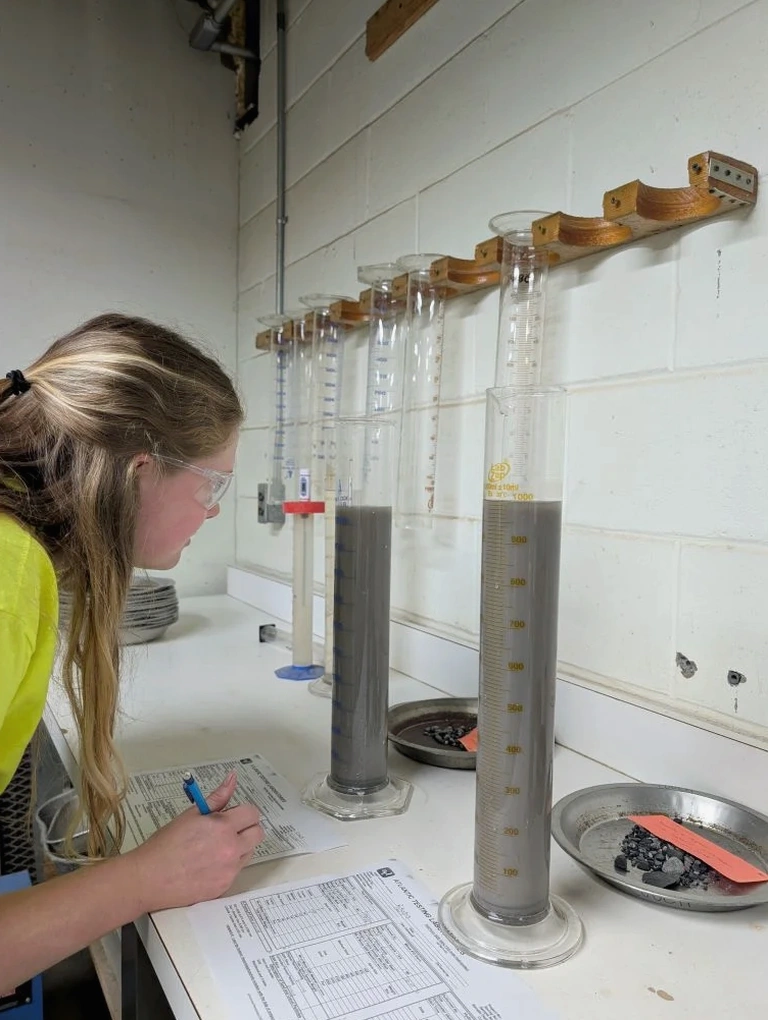
Risks and considerations in Brownsville Texas
The Rio Grande Valley's semi-arid subtropical climate creates a testing paradox that inexperienced engineers miss entirely. Brownsville averages 27 inches of rain annually, but the distribution is anything but uniform — tropical systems in late summer can dump 8 inches in 48 hours on soils that have been baking under 95-degree heat for months. A subgrade that held up perfectly during the dry season turns into a saturated, low-strength layer the moment construction traffic or the first heavy rain arrives. The laboratory CBR test simulates this worst-case scenario through the 96-hour soak, and the numbers tell a sobering story. We have tested Beaumont clay samples where the unsoaked CBR registered 12% — a decent subgrade by any standard — only to see the soaked value collapse to 1.8% after four days of saturation. That kind of drop means the pavement design based on unsoaked values is off by a factor of three or more in structural number. For Brownsville's arterial roads, school parking lots, and industrial yards near the port, skipping the soaked CBR is not a calculated risk — it is a guaranteed pavement failure within the first two wet seasons.
Our services
Our Brownsville laboratory provides CBR testing as part of a complete subgrade evaluation package tailored to the soils of Cameron County and the lower Rio Grande Valley. We work with local geotechnical firms, civil contractors, and municipal agencies who need reliable soaked and unsoaked CBR values for pavement thickness design. Turnaround is typically 5 to 7 business days from sample receipt, with rush options available for tight construction schedules.
Soaked Laboratory CBR Test (ASTM D1883)
Complete 96-hour soaked CBR determination on remolded samples compacted at optimum moisture content per ASTM D698. Includes swell measurement during soaking, penetration testing at 0.05 in/min, and corrected CBR values at 0.1-inch and 0.2-inch penetration. Suitable for Texas DOT pavement design submittals and all municipal road projects in Brownsville.
CBR with Lime Stabilization Evaluation
Comparative CBR testing on native soil and lime-treated blends at varying percentages (3%, 5%, 7% hydrated lime) to determine optimal stabilizer content. Essential for Brownsville projects where expansive clays with plasticity indices above 25 require chemical modification. Includes pH testing and 7-day cured strength verification.
Questions and answers
What is the difference between laboratory CBR and field CBR for a Brownsville project?
The laboratory CBR per ASTM D1883 tests soil compacted under controlled conditions in a 6-inch mold, with a standardized 96-hour soaking period to simulate worst-case saturation. Field CBR by ASTM D4429 uses a portable device pushed directly into the subgrade. In Brownsville, the laboratory soaked CBR is the value used for pavement thickness design because it accounts for the moisture sensitivity of the Valley's clays — something a field test during dry weather can completely miss. For design purposes, the lab test is mandatory under Texas DOT specifications.
How much does a laboratory CBR test cost in Brownsville?
What CBR value is considered acceptable for roads in Brownsville?
Texas DOT generally requires a minimum soaked CBR of 5% for subgrade under flexible pavements, though values as low as 3% may be accepted with increased pavement thickness or subgrade treatment. In Brownsville, many native clays from the Beaumont Formation test between 1.5% and 4% soaked, which means lime or cement stabilization is standard practice before base course placement. For heavy industrial pavements near the port, target CBR values of 8% to 10% are common, often requiring 6 inches or more of lime-treated subgrade.