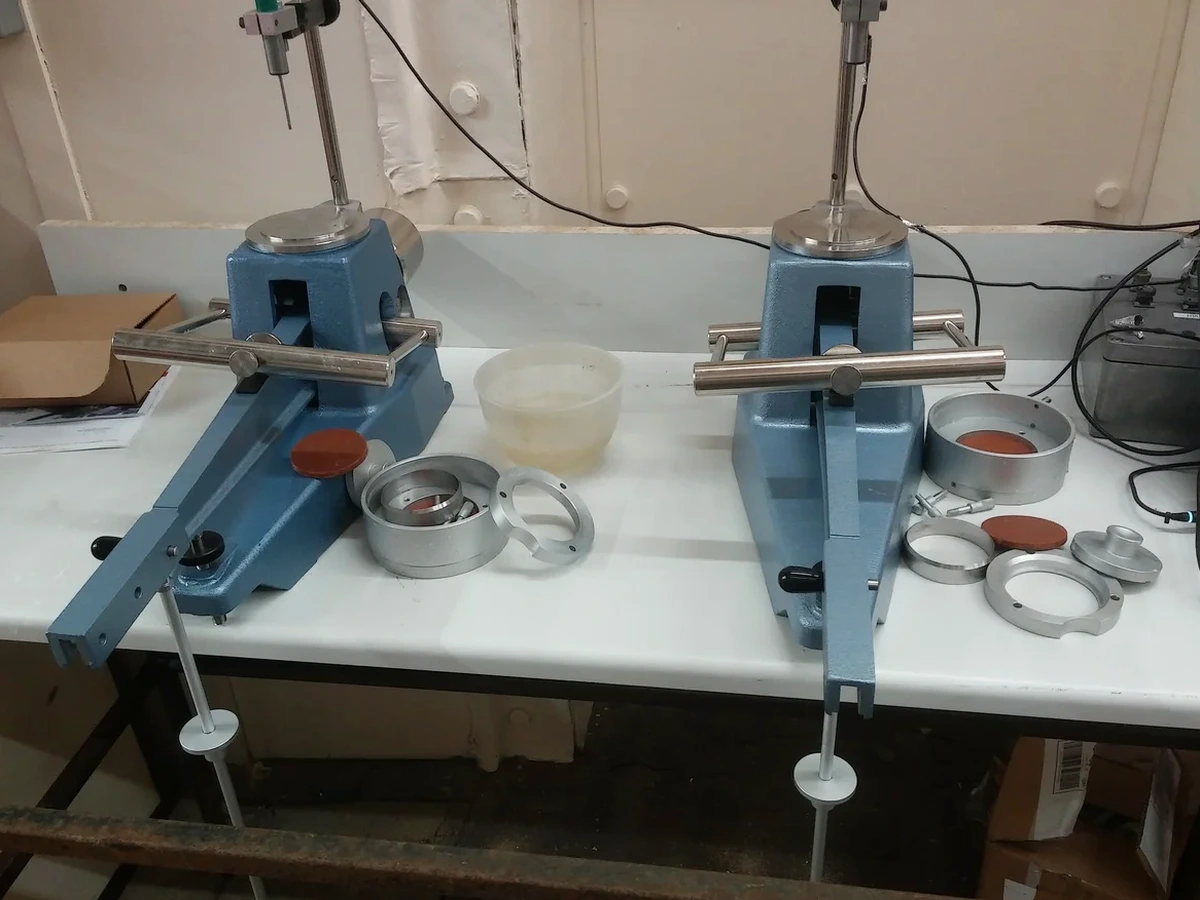
The deltaic clays of the Rio Grande Valley near Brownsville Texas shift from lean to fat clay across a single construction site. At 25.9°N and 97.5°W, the Holocene-age alluvium and Beaumont Formation sediments produce liquid limits that routinely exceed 50 in low-lying tracts south of Boca Chica Boulevard. When moisture content crosses the plastic limit during a wet spring, the subgrade loses bearing capacity in hours. Our lab performs Atterberg limits testing per ASTM D4318-17e1 to classify these fine-grained materials under the Unified Soil Classification System. The data feeds directly into foundation design, retaining wall backfill specs, and pavement subgrade preparation. For projects in Brownsville Texas where the groundwater table sits within four to six feet of the surface, even small shifts in plasticity index affect earthwork decisions. We combine the Atterberg limits with a grain-size analysis to distinguish silt from clay fractions, and with in-situ permeability tests to model drainage behavior beneath slab-on-grade foundations.
Plasticity index in Brownsville clays can swing eight points across the same terrace deposit. A single Atterberg test isn't enough; you need the transect.
Technical details of the service in Brownsville Texas
Risks and considerations in Brownsville Texas
In the resacas and old oxbow depressions scattered across Brownsville Texas, we consistently see fat clays with plasticity indices above 35. These soils swell when wetted and shrink during the long dry spells that characterize the lower Rio Grande Valley climate. A slab poured on such material without a PI value in the geotechnical report will crack within the first two years. The Texas Department of Transportation Standard Specifications Item 132 requires Atterberg limits on every borrow source before it hits the grade. Skipping the test doesn't just violate spec; it transfers the volumetric instability risk from the earthwork contractor to the owner. In seismic terms, the ASCE 7-22 site class for fine-grained soils depends partly on the plasticity index. A PI above 20 can push a site from Site Class D into Site Class C under the NEHRP provisions, which changes the design spectral acceleration and may reduce the seismic demand on the structure. That number, derived from a simple Atterberg limits test, alters the structural cost by thousands of dollars on a commercial building in Brownsville Texas.
Our services
Our Brownsville Texas laboratory provides two standardized Atterberg limits packages. Both include the complete index property report with USCS and AASHTO classification, suitable for geotechnical baseline reports, earthwork specifications, and forensic investigations of distressed pavement.
Standard Atterberg Limits Package
Liquid limit by Casagrande cup, plastic limit by thread-rolling, and calculated plasticity index on a single sample. Includes moisture content, USCS group symbol, and AASHTO classification. Typical turnaround: 24 hours. Suitable for routine borrow source verification and subgrade characterization.
Multi-Point Atterberg with Proctor Correlation
Atterberg limits run on three or more samples from the same borrow source or depth profile, plus a standard or modified Proctor on the representative bulk sample. We plot PI versus optimum moisture content to verify the compaction curve shape. Recommended for high-PI Brownsville clays where stabilization with lime or cement is under consideration.
Questions and answers
What is the cost of an Atterberg limits test in Brownsville Texas?
How much sample material do you need to run Atterberg limits?
We require approximately 200 grams of material passing the No. 40 sieve (0.425 mm) for a complete Atterberg limits determination. The sample should be taken from a representative portion of the fine-grained stratum and sealed in a moisture-tight container immediately after collection. If the material contains particles larger than the No. 40 sieve, we process it through wet sieving in the lab before testing.
Why are Atterberg limits important for foundation design in the Rio Grande Valley?
The plasticity index directly controls the swell-shrink potential of the fine-grained soils found in Brownsville Texas. A PI above 25 indicates high expansion potential, which requires engineered measures such as moisture-conditioned fill, lime stabilization, or deepened footings. The Atterberg limits also determine the USCS classification used to select allowable bearing pressure from the IBC presumptive load-bearing values table.
Can you run Atterberg limits on samples we already have?
Yes, we accept both Shelby tube samples and bag samples from active construction sites in Brownsville Texas. The sample must be identified with the project name, boring number, depth interval, and date of collection. We log the chain of custody upon receipt and report the results with the same metadata in the final geotechnical data sheet.