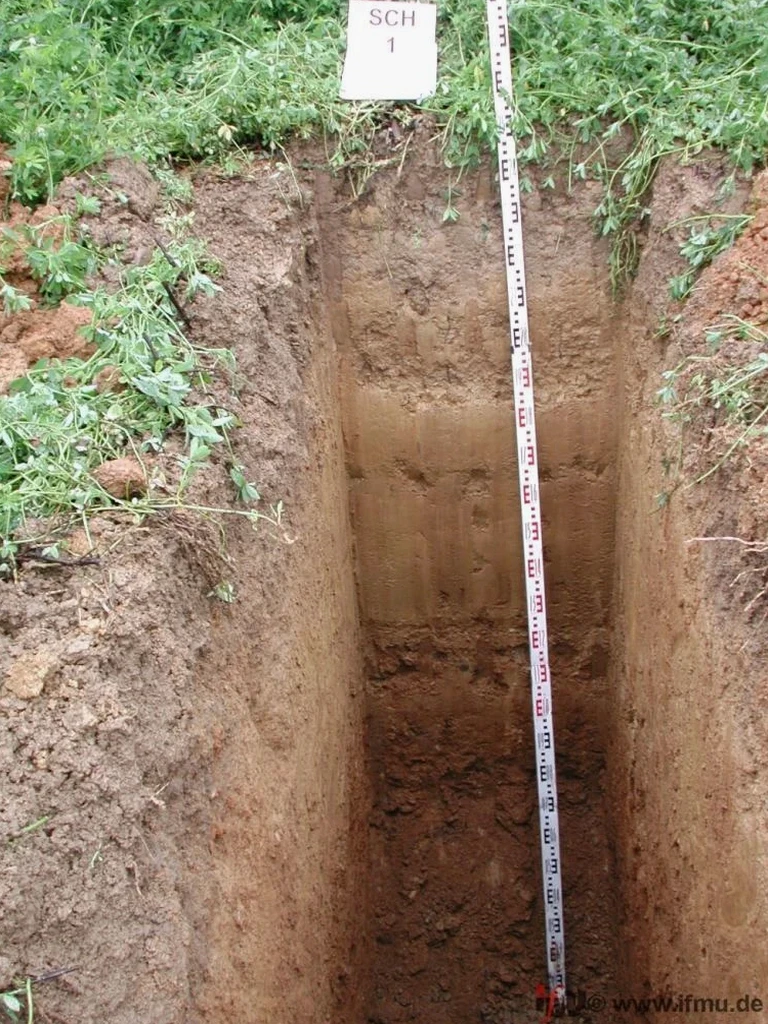
A tracked excavator positions itself on the parcel near the resaca, its bucket cutting through the first few feet of Brownsville's characteristic deltaic clay. Within hours we have a clean vertical face that exposes the stratigraphy down to eight or ten feet, allowing our geologist to log the sequence directly—no cuttings, no disturbed samples, just the formation as it sits in place. This is the exploratory test pit, and for near-surface investigations in the Rio Grande Valley it remains one of the most decisive tools available. When groundwater is shallow, as it often is west of the Port of Brownsville, the open excavation gives us an immediate read on seepage rate and contact zones that a boring log can only approximate. We pair the visual log with bulk sampling from each distinct horizon, then run laboratory classification under ASTM D2487 to confirm field identifications before the trench is backfilled and the site is graded clean.
An open excavation gives you the one thing no split-spoon sample can: a continuous, full-scale view of the contact between strata and how groundwater actually moves through the formation.
Technical details of the service in Brownsville Texas
Risks and considerations in Brownsville Texas
Brownsville sits at approximately 33 feet above mean sea level on a coastal plain where hurricane storm surge and river flooding have shaped the geomorphology for millennia. A test pit that is dug but not properly backfilled becomes a sinkhole waiting to happen when the next heavy rain saturates the uncompacted fill—we have seen subsidence of six inches or more in older neighborhoods where utility trenches were closed without mechanical compaction. The bigger structural risk is missing a soft lens entirely: if the excavator bucket stops one foot above a saturated silt layer that will consolidate under the footing load, the differential settlement will show up as drywall cracks within the first two years of occupancy. OSHA 1926 Subpart P governs excavation safety on every job, and in Brownsville's cohesive Beaumont clays the short-term stand-up time is usually adequate, but we never assume it—our field lead checks the face at the start of each shift and after any rainfall.
Our services
Every exploratory test pit we open in Brownsville is part of a broader geotechnical workflow that starts with the surface observation and extends into the lab. The four services below represent the most common combinations our clients request when they need actionable data from a test pit program.
Test Pit Excavation and Logging
Mechanical excavation with a mid-size excavator, vertical face trimming, and detailed in-situ logging by a field geologist using the USCS classification. We photograph each face, measure strata thickness, and note seepage, root penetration, and fill boundaries.
Bulk and Undisturbed Sampling
Collection of 50-lb bulk bags from each distinct horizon for laboratory index testing, plus thin-wall Shelby tube samples driven from the pit floor when we need to capture the undisturbed structure of a sensitive clay or silt layer.
Percolation and Infiltration Testing
On-site measurement of water inflow rate into the open pit, combined with falling-head tests in a cased boring adjacent to the excavation, to provide the percolation rates required for stormwater detention basin design in Brownsville's low-gradient terrain.
Compacted Backfill and Surface Restoration
Mechanical compaction of backfill in maximum 8-inch lifts with density verification by nuclear gauge or sand cone, finished with topsoil replacement and grading to match the surrounding grade—critical when the test pit is located inside an existing parking lot or landscaped area.
Questions and answers
How much does an exploratory test pit cost in Brownsville?
How deep can you go with a test pit in the Brownsville clays?
With a standard mid-size excavator we routinely reach 12 to 15 feet in the stiff Beaumont Formation clays that underlie most of the city. Deeper than that requires benching the sides or stepping the pit, which widens the footprint considerably. For investigations below 15 feet we usually recommend switching to SPT drilling at the same mobilization.
Do I need a permit to open a test pit on my property in Brownsville?
Most private-lot investigations do not require a city permit, but you must call Texas811 at least 48 hours before we dig so all underground utilities can be located and marked. If the pit is within the public right-of-way or inside a TxDOT corridor, a separate encroachment permit is necessary and we can help coordinate that process. More info.