Brownsville sits at roughly 33 feet above sea level on the deep alluvial deposits of the Rio Grande delta, where the water table can be just a few feet below the surface during wet seasons. Those numbers matter when you are placing structural loads on soils that are predominantly soft clays, silts, and loose sands deposited over millennia. In our experience, the difference between a foundation that performs for decades and one that starts showing distress in five years comes down to how well the pile design accounts for these local conditions. A proper pile foundation design in this part of Texas requires more than just applying a generic bearing capacity formula — it demands understanding how the deltaic stratigraphy varies block by block, which is why we combine geotechnical data from SPT drilling with laboratory index tests before selecting pile type, length, and capacity.
In the Rio Grande delta, negative skin friction from consolidating clays can add more load to a pile than the structural dead load it carries.
Technical details of the service in Brownsville Texas
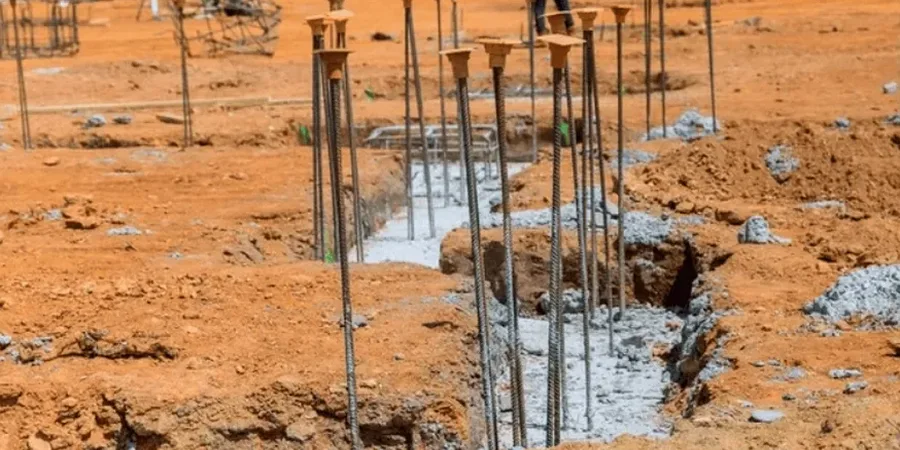
Risks and considerations in Brownsville Texas
A three-story medical office building near the Brownsville South Padre Island International Airport started showing diagonal cracking in the stairwell walls within 18 months of completion. The investigation revealed that the original design used shallow footings bearing on what the borings described as stiff clay — but the borings were taken during a drought year when the water table was 12 feet down. During normal wet cycles, the clay softened and differential settlement exceeded two inches between column lines. We were brought in to design a retrofit with micropiles drilled through the active zone and socketed into the deeper Pleistocene sand, and the lesson stuck: in this city, seasonal moisture cycles and floodplain dynamics make deep foundations the prudent choice for any structure where tolerance for movement is low. Ignoring the water table variability in Brownsville is not a calculated risk — it is gambling with the building envelope.
Our services
Our deep foundation work in Brownsville covers the full design lifecycle, from initial geotechnical investigation through construction-phase testing and as-built documentation. Because the subsurface conditions here vary so much — even between lots on the same street — we structure our approach around the specific risk profile of each project rather than applying a template.
Geotechnical Investigation for Pile Design
We execute SPT borings, CPT soundings, and laboratory testing programs to characterize the deltaic stratigraphy at the project site. Every investigation includes groundwater monitoring over at least one seasonal cycle and classification testing per ASTM D2487 to feed accurate soil parameters into the pile capacity calculations.
Axial and Lateral Pile Capacity Analysis
Using the site-specific soil parameters, we perform static capacity calculations (alpha, beta, or CPT-based methods) and lateral response analysis with p-y curves. We evaluate single pile and group behavior, accounting for group efficiency factors and the potential for downdrag from the soft clay layers that dominate the upper 30 feet in Brownsville.
Pile Load Testing and Construction Oversight
We specify and interpret static load tests, high-strain dynamic testing (PDA), and integrity testing (PIT) to verify that installed piles meet the design assumptions. Our field engineers monitor driving records, concrete placement, and casing extraction on drilled shafts to ensure the as-built foundation matches the design intent.
Questions and answers
How deep do piles typically need to go in Brownsville for a mid-rise building?
For the three-to-five-story structures common along the Brownsville commercial corridors, we usually target bearing in the Pleistocene-age sands at 45 to 70 feet below grade. The exact depth depends on the site-specific stratigraphy and the structural loads, but the soft deltaic clays in the upper 30 to 40 feet generally do not provide reliable end bearing for heavily loaded piles without unacceptable settlement.
What type of pile works best in the expansive clay soils of the Rio Grande Valley?
Drilled shafts with full-length casing or driven precast concrete piles both work well here. The key is to extend the pile through the active zone of moisture fluctuation — typically the upper 15 to 20 feet — and into stable material below. We also evaluate the need for a void form or an isolation layer beneath grade beams to prevent expansive clay from lifting the structure between pile caps.
What does a pile foundation design study cost in Brownsville?
Do you need to consider hurricane storm surge in pile design for Brownsville projects?
Yes, absolutely. Brownsville's location on the Gulf Coast means that pile foundations must be checked for scour depth during storm surge events per HEC-18 guidelines, and the pile-to-cap connection must resist uplift from buoyancy and wave action. We use ASCE 7 flood load provisions and local FEMA flood maps to determine the design scour elevation and ensure the piles have adequate embedment below that depth.