The Rio Grande Valley's deltaic deposits create some of the most challenging foundation conditions in Texas. Brownsville sits on deep Quaternary alluvium, layers of fat clay interspersed with silty sand lenses that swell when wet and shrink during our brutal summer droughts. Seasonal moisture swings can exceed 4 inches of vertical movement in untreated fat clay. A mat foundation distributes structural loads across a broad footprint rather than concentrating them at isolated points. Our geotechnical team logs every boring with ASTM D2487 visual-manual classification before a single calculation begins. The lab's Proctor curves and Atterberg limits feed directly into the bearing capacity model, ensuring the design reflects actual subsurface behavior, not textbook assumptions.
In the Valley's expansive clays, a properly designed mat isn't an upgrade. It's the difference between a structure that moves with the seasons and one that stays put for decades.
Technical details of the service in Brownsville Texas
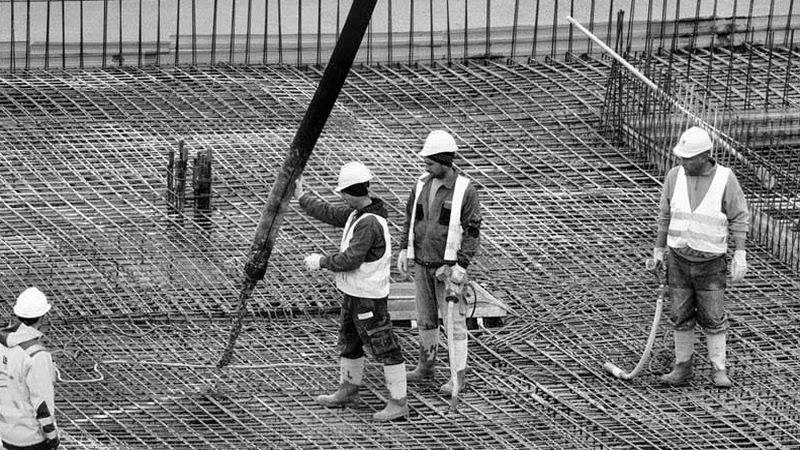
Risks and considerations in Brownsville Texas
A strip mall on Boca Chica Boulevard went up in 2018 on isolated footings despite soil reports showing PI values over 35. Within two years, drywall cracks ran diagonally from every window corner. Differential settlement in Brownsville's fat clays rarely exceeds an inch total, but half an inch across 20 feet of slab edge can shear partition walls and bind doors. A rigid mat foundation ties the entire footprint together, forcing settlement to occur uniformly. Our scope includes monitoring during the first wet season after construction: four settlement plates, read monthly, with triggers set at 0.25 inches differential before the warranty period expires.
Our services
Our Brownsville lab runs the full sequence: field exploration, lab testing, structural modeling, and construction-phase verification. Each phase feeds the next.
Subsurface Exploration & Sampling
Hollow-stem auger borings to 30–50 ft depth with SPT sampling per ASTM D1586. Shelby tubes in fat clay zones for undisturbed consolidation and swell testing. Groundwater monitoring wells installed when the water table is within 10 ft of the slab bearing elevation.
Geotechnical Parameter Derivation
We run one-dimensional consolidation (ASTM D2435), unconfined compression on clay cores, and Atterberg limits on every distinct stratum. The lab report includes modulus of subgrade reaction (k) back-calculated from consolidation curves, not just empirical tables.
Structural Mat Design & Detailing
Finite element modeling of the slab-soil interaction using the derived k-value profile. Reinforcement schedules for top and bottom mats, punching shear checks at columns, and construction joint details with waterstop specifications for high-groundwater sites near the resacas.
Questions and answers
What does raft/mat foundation design cost for a commercial building in Brownsville?
How deep do borings need to go for a mat foundation in the Valley?
We typically extend borings to a depth where the stress increase from the mat is less than 10% of the existing overburden pressure. In Brownsville's deep alluvium that often means 30 to 50 feet. If a denser stratum is encountered above that depth, we may terminate earlier with the engineer's approval.
How do you handle the high sulfate content in Brownsville groundwater?
We sample groundwater during drilling and test for sulfate concentration in the lab. Above 1,500 ppm, ACI 318 requires Type V cement or equivalent sulfate-resistant mix designs. Our concrete specifications include a maximum water-cement ratio of 0.45 and a minimum 4,000 psi compressive strength for sulfate exposure class S2 or S3.
What's the difference between a stiffened slab-on-grade and a true structural mat?
A stiffened slab uses deepened perimeter and interior beams to resist edge heave in expansive soils. It works for light residential loads. A structural mat is a uniformly thick reinforced slab designed to carry heavy column loads and distribute them across the entire footprint. It's the right choice when bearing pressures exceed 1,500 psf or column spacing is under 20 feet.