Brownsville is a city of soil contrasts. Over in the historic West Brownsville grid, you might hit sandy loam that drains well; just a few blocks south toward the resacas, the profile turns into a sticky, fat clay that holds water for days. Both materials behave completely differently under a slab or a pavement, and that is exactly why a full grain size analysis matters. The hydrometer adds the fine fraction data that a simple sieve test misses. On a recent project near the Port of Brownsville, we saw a mix of windblown sand and dark organic silt where the clay content jumped from 8% to 35% in less than three feet. Without the hydrometer curve, the contractor would have overestimated the bearing capacity. Whether you are working in Brownsville, Los Fresnos, or along Boca Chica Boulevard, the soil texture drives your foundation and compaction decisions.
In Brownsville, a sieve-only curve hides the clay danger. The hydrometer reveals the 15-40% fines that dictate settlement and shrink-swell behavior.
Technical details of the service in Brownsville Texas
Risks and considerations in Brownsville Texas
In Brownsville, we repeatedly see a pattern that a local technician learns to recognize: a contractor sends in a sample thinking it is just sandy fill, and two days later the report flags 22% clay. That changes the compaction spec from standard Proctor to a modified effort, and it voids the original pavement design. The Rio Grande Valley has discontinuous clay lenses left by old river meanders, and they appear exactly where you would not expect them. If the grain size analysis skips the hydrometer, the gradation curve cuts off at the No. 200 sieve and the entire fine fraction becomes invisible. The consequence is a structure that settles differentially because the drainage layer is actually a moisture-sensitive silt. We have seen stem wall cracks in Brownsville subdivisions traced directly to a missing hydrometer test. For any project east of I-69E or within the floodplain influence zone, the combined sieve-plus-hydrometer analysis is not optional; it is the minimum required to classify the soil correctly under the IBC and the City of Brownsville building code.
Our services
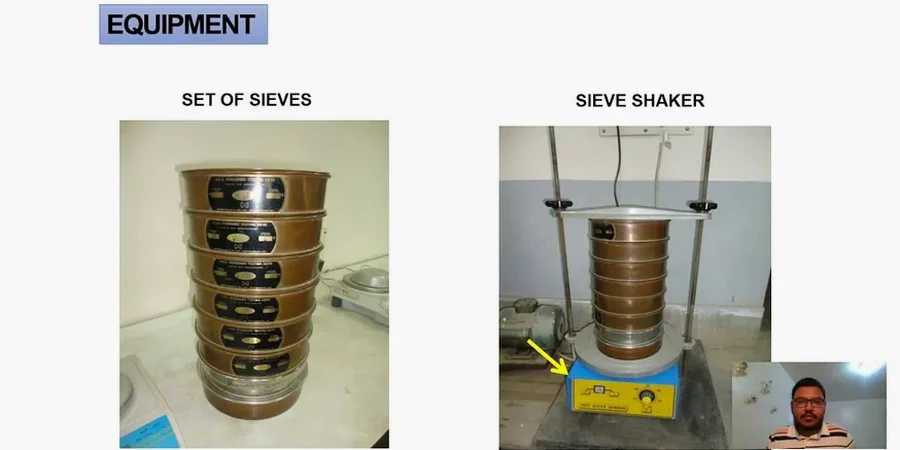
Our Brownsville lab runs two complementary grain size packages depending on the material and the project specification. Both include the full combined curve and the USCS classification.
Full Sieve + Hydrometer Package (ASTM D422/D6913 + D7928)
Complete mechanical sieving from No. 4 to No. 200 plus sedimentation hydrometer for the minus-200 fraction. Includes oven-dry moisture, wash loss, Cu and Cc coefficients, and USCS group symbol. The standard package for foundation investigations, retaining wall design, and pavement subgrade evaluation in Brownsville.
Wet Sieve + Hydrometer for Cohesive Soils
Designed for fat clays and organic silts common in the resaca zones of Brownsville. The sample is wet-sieved to preserve aggregates, then the fines are analyzed with the hydrometer at the standard time intervals. We report the full particle-size distribution curve and the clay fraction percentage critical for shrink-swell assessment.
Questions and answers
How much does a grain size analysis with hydrometer cost in Brownsville?
How long does the hydrometer test take compared to a simple sieve analysis?
The sieve portion is finished in one working day. The hydrometer adds about 24 hours of sedimentation readings, plus 8 hours of sample preparation including drying, washing, and dispersion. We typically deliver the full combined report in three business days for a standard project in the Brownsville area.
Why can't I just run a sieve analysis and skip the hydrometer?
A sieve analysis stops at the No. 200 sieve and tells you nothing about the silt and clay fractions. In Brownsville, where clay lenses from old river channels are common, skipping the hydrometer means you miss the percentage of material that controls settlement, drainage, and shrink-swell behavior. The IBC and ASTM D2487 require the full curve to assign a correct USCS group symbol.
What sample size do you need from the site in Brownsville?
For a combined sieve and hydrometer test, we need at least 500 grams of dry material for sandy soils and 200 grams for fine-grained soils. The sample should be bagged in a sealed plastic bag to preserve the natural moisture, and we can receive it directly at our Brownsville lab or arrange pickup on larger projects. More info.