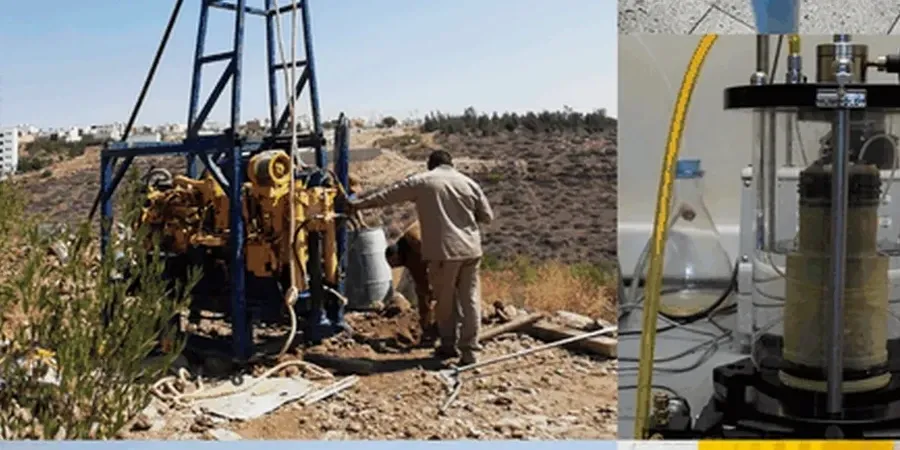
The excavator bucket hits water at 6 feet. That is Brownsville. Our team sizes shoring systems by first running the SPT drilling rig on site—usually a CME-75 mounted on a flatbed to handle the soft clay access paths. We log every 2-foot split spoon sample, measure blow counts in the loose Holocene silts, and hand the data straight to the shoring designer. No guesswork. The Rio Grande delta deposits shift from sandy fill to fat clay within a single boring, so we correlate field logs with lab index tests before any excavation plan leaves the office. Brownsville’s 25.92°N latitude means year-round construction season, but the high groundwater table does not take a holiday. Our designs account for buoyant forces, seepage gradients, and the low effective stress that makes unsupported cuts collapse fast in Cameron County.
In Brownsville, designing an excavation without accounting for the 6-foot groundwater table is just planning a swimming pool.
Technical details of the service in Brownsville Texas
Risks and considerations in Brownsville Texas
In Brownsville, we have seen open cuts stand vertical in dry clay for two days and then collapse in four hours when a thunderstorm rolls in from the Gulf. It only takes one rain event. The biggest hazard we document is basal heave in wide excavations where the confining pressure is removed faster than the clay can drain. That soft Lomalta clay layer at 10 to 20 feet depth acts like a hydraulic plug—water builds up underneath and the bottom blows upward, cracking the slab before the rebar is even tied. We model this with limit equilibrium methods, checking factor of safety against heave below 1.5. Adjacent structures add surcharge loads that shift the active wedge further back than the property line drawing shows. A retaining wall next door carrying a two-story building is not just a boundary—it is a lateral load on your excavation face. We survey existing foundations, map their depth, and incorporate the offset distance into the shoring calculations. Miss that step and you will be on the phone with the neighbor’s insurance adjuster within the week.
Our services
Our scope for Brownsville excavation projects covers the full chain from field investigation to stamped construction drawings. We deliver a package that the city building department can review without sending back for missing soil parameters.
Shoring design and wall analysis
We size sheet pile sections, soldier beam spacing, and waler levels using active/passive earth pressure envelopes per FHWA guidelines. Cantilever, anchored, and braced configurations are checked for bending moment, shear, and deflection.
Dewatering and groundwater control plans
Pumping test interpretation, wellpoint spacing, and sump layout for the high water table conditions typical of Brownsville’s deltaic soils. We estimate steady-state flow rates to size pumps and sedimentation controls.
Settlement and vibration monitoring specs
We set threshold values for adjacent structures based on condition surveys and distance. Monitoring points and reading frequency are specified before the first bucket breaks ground.
Peer review and plan submittal support
Our calculations are formatted for City of Brownsville plan check, with soil parameters backed by lab reports from our ISO 17025-certified testing facility. We respond to review comments within 48 hours.
Questions and answers
How deep can you excavate in Brownsville before shoring is required?
OSHA 1926 Subpart P classifies Type C soil as the default for Brownsville’s silty clays and loose sands, which means any vertical cut deeper than 4 feet requires a protective system. Our geotechnical reports classify the soil type based on lab test results, and we specify the appropriate shoring or sloping angle. In practice, most commercial excavation plans in Cameron County begin shoring design at 8 to 10 feet depth.
What does deep excavation geotechnical design cost in Brownsville?
How do you handle groundwater during excavation in the Rio Grande Valley?
Groundwater in Brownsville is commonly found between 4 and 8 feet below grade. We design either a perimeter wellpoint system with continuous pumping or a deep sump and pump approach, depending on soil permeability measured from in-situ tests. The dewatering plan includes flow rate estimates, discharge location, and erosion control measures to keep the excavation bottom dry and stable.
Do you monitor adjacent buildings during excavation?
Yes, we specify crack gauge installation on neighboring structures, survey points for optical monitoring, and vibration limits when rock or hard clay layers require hoe ramming. The monitoring plan defines trigger levels—typically 1/4 inch of settlement—that pause work and trigger a review before proceeding. This protects both your project and the surrounding properties in downtown Brownsville.